
Enhancing Cloud Security Governance Strategies With Google Cloud Platform

This article explains approaches to strengthening governance for cloud security when workloads and data are hosted on the Google Cloud service suite. It describes the concept of aligning organizational policies, technical controls, and operational processes so that cloud resources are managed consistently and risks are assessed continuously. The discussion focuses on governance structures, control families, and measurable activities that commonly appear in organizational efforts to reduce misconfiguration, enforce access controls, and maintain visibility over cloud environments.
Governance in this context typically covers policy definition, assignment of responsibilities, enforcement mechanisms, monitoring, and review cycles. It may include mapping organizational roles to cloud identity constructs, creating constraints at the resource hierarchy level, and defining detection and response capabilities. The emphasis is on creating repeatable, observable patterns that can be integrated into development and operations workflows and that support compliance and risk management objectives without implying guaranteed outcomes.
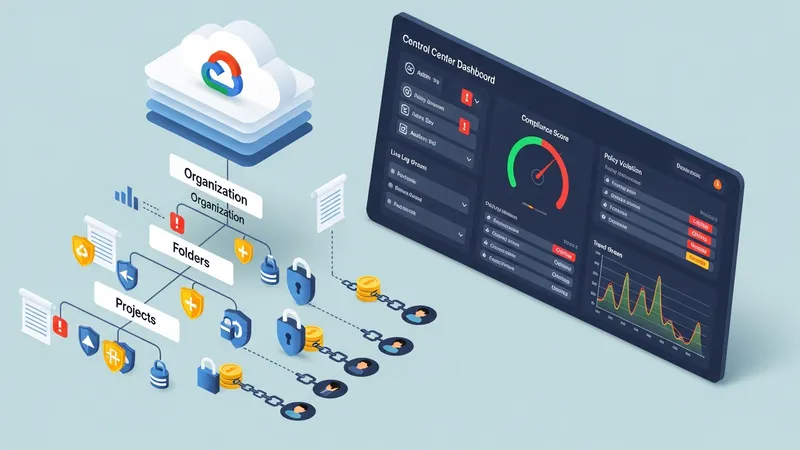
- Identity and Access Management controls: Centralized role and permission structures, service account handling, and conditional access mechanisms for human and machine identities.
- Resource hierarchy and policy constraints: Organization-level policies, folders and projects for scoping, and constraint-based controls to limit configurations at scale.
- Monitoring and threat detection tools: Centralized logging, security posture assessment, and alerting systems that provide continuous visibility and actionable signals for investigations.
Identity and access controls form a core example of governance because they determine who or what can act on cloud resources. In practice, organizations may use role-based models, scoped service accounts, and short-lived credentials to reduce standing privileges. Access reviews and automated policy checks can be integrated into identity lifecycles. These approaches typically aim to limit exposure by aligning cloud identities with organizational roles and by capturing access events in audit logs for later review.
Resource hierarchy and policy constraints illustrate how governance can be applied at scale. By grouping projects under folders and an organization node, teams can attach constraints that prevent certain configurations, such as disabling public IPs or restricting region placement. Policy-as-code approaches may be used to codify constraints and validate deployments before they reach production. Such structures often help teams enforce baseline settings consistently while allowing controlled exceptions where necessary.
Network and perimeter controls are another governance dimension that commonly receives focused attention. Segmentation, private connectivity options, and perimeter services can be used to reduce exposure of sensitive workloads. Control implementations often include firewalls, service perimeters, and private access paths that work together with identity controls. Network governance typically includes documented patterns for segmentation and testing procedures to validate isolation objectives.
Monitoring and threat detection complete the governance loop by turning observable events into signals for action. Centralized collection of logs, metrics, and configuration snapshots may be used to assess posture and detect anomalies. Security posture tools may provide inventories of misconfigurations and known exposures, while alerting pipelines route incidents to response teams. Governance arrangements often specify retention, access to forensic records, and periodic review intervals aligned with organizational risk tolerance.
In summary, strengthening governance for cloud security on the Google Cloud service suite typically involves coordinating identity controls, resource-level policies, network segmentation, and monitoring into a cohesive program. Each component may be implemented using policy-as-code, automated validation, and defined operational roles so that changes can be tracked and reviewed. The next sections examine practical components and considerations in more detail.